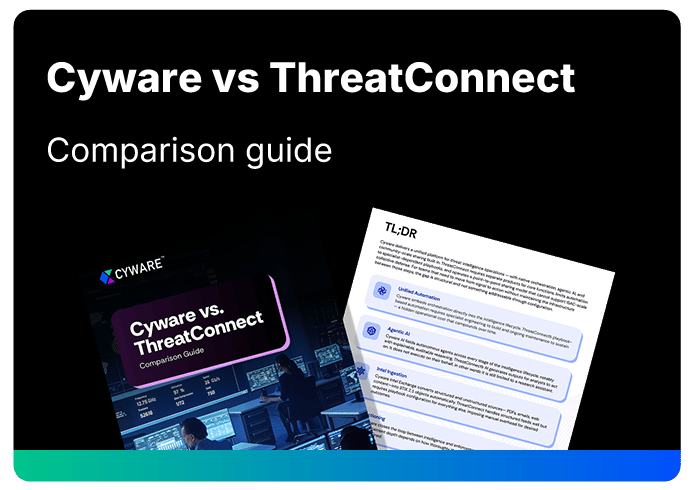
Comparison Guide
Cyware vs. ThreatConnect
Is Your Assembled Stack Holding You Back?
Most teams are stitching together three separate products just to cover what a unified platform should handle natively. Find out if your current setup is creating operational gaps - or closing them.
Unified Platform or Assembled Stack?
Is your team managing separate licenses for orchestration, sharing, and case management, or does everything run natively from a single platform?
Autonomous Execution or Analyst Hand-off?
Does AI act autonomously across the intelligence lifecycle with explainable reasoning, or does it produce outputs that still require an analyst to take the next step?
ISAC-Scale Sharing or Point-to-Point?
Can your platform distribute intelligence across entire communities in real time, or does sharing scale only as far as your manual partner connections go?
Don't let infrastructure gaps dictate your defense. See how Cyware outperforms legacy platforms across 5 critical dimensions.
Download the Full Comparison Guide Now

Why Cyware
One Platform. Every Stage of the Threat Intelligence Lifecycle.
While most platforms manage intelligence in silos, Cyware unifies the entire TIOps lifecycle in one connected platform — from ingestion and enrichment to orchestration, sharing, and case management.
This guide examines five capability areas where Cyware's architecture delivers a measurable operational advantage:
- Replace three separately licensed products with one unified platform — no integration overhead, no missing modules.
- Deploy autonomous AI agents that execute enrichment, profiling, and actioning — with full explainability at every step.
- Convert PDFs, emails, and unstructured web content into structured STIX 2.1 objects automatically, without playbook configuration.
- Join the backbone of collective defense powering over 85% of global ISACs and bi-directional sharing.

Trusted by the world’s leading organizations.